

AI is everywhere right now. You see it in marketing tools, sales software, customer support platforms, and even accounting dashboards. Everyone seems to be “using AI,” yet when you sit down to apply it to your own business, the path forward feels unclear.
You may be asking yourself:
- Which AI tool should I start with?
- How do I avoid wasting money on tools I won’t use?
- Will this actually help my business—or just add complexity?
This hesitation isn’t a lack of ambition. It’s a lack of structure.
Small businesses don’t fail at AI adoption because the technology doesn’t work. Instead, they fail because they jump in without a plan, chase shiny tools, or try to do too much too quickly.
This article is your practical, step-by-step AI adoption roadmap—designed specifically for small businesses. It avoids technical jargon, skips the hype, and makes no unrealistic promises. Instead, it offers a clear framework you can follow to integrate AI in a way that actually saves time, reduces stress, and improves decision-making.
Think of this roadmap as building a reliable AI system, not experimenting with random tools.
Why Most Small Businesses Struggle With AI Adoption
Before jumping into solutions, it’s important to understand why AI adoption often feels harder than it should.
The Core Problem: Too Much Choice, Not Enough Direction
AI tools are no longer scarce—they’re overwhelming.
For almost every task, there are:
- Multiple platforms
- Overlapping features
- Aggressive marketing claims
As a result, business owners often freeze or make rushed decisions.
Common AI Adoption Mistakes
Most failed AI efforts fall into these patterns:
- Tool Overload
You sign up for several AI tools at once, test each briefly, and abandon them all. Nothing sticks, and confidence drops. - Solving the Wrong Problem
You invest in advanced analytics or automation before fixing basic workflow issues—like manual follow-ups or inconsistent content creation. - No Internal Buy-In
AI is introduced without explanation or training, so team members avoid it or use it incorrectly. - Expecting Instant Transformation
AI is treated as a magic switch instead of a system that improves gradually with use.
Because of this, AI ends up feeling like another failed productivity experiment rather than a long-term advantage.
The Core Insight: AI Adoption Is a Process, Not a Project
Successful AI adoption doesn’t happen in a weekend. It happens step by step.
The most effective small businesses treat AI like a new hire:
- Start with one responsibility
- Measure performance
- Improve gradually
- Expand only when results are clear
This mindset removes pressure and creates momentum.
Instead of asking:
“How do we become an AI-powered company?”
You ask:
“What’s one repetitive task we can make easier this month?”
That single shift changes everything.
The 6-Step AI Adoption Roadmap for Small Businesses
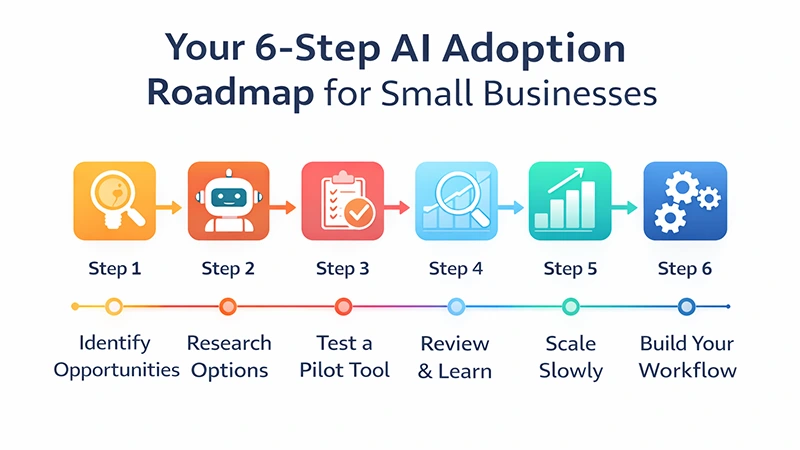
Follow these steps in order. Each one builds on the previous step. Skipping ahead increases confusion instead of progress.
Step 1: Identify High-Friction Tasks (Week 1)
Goal: Find the tasks that quietly drain time and energy.
AI delivers the most value when it removes repetition, not creativity or strategy.
What to Do
Set aside 30 minutes and answer these questions honestly:
- Which tasks feel repetitive every week?
- What work do I delay because it feels tedious?
- Where do mistakes happen simply because it’s manual?
Common Examples
Most small businesses identify tasks like:
- Writing social media captions repeatedly
- Responding to the same customer questions
- Manually following up with leads
- Formatting reports or summaries
- Scheduling meetings and reminders
Output of Step 1
A short list of 3–5 recurring pain points.
Not goals. Not ideas.
Just friction.
Step 2: Match One Task to One AI Tool (Week 2)
Goal: Avoid overwhelm by choosing a single, targeted solution.
This step is where many businesses go wrong. They research “best AI tools” instead of solving their problem.
How to Choose Correctly
Use this logic:
- One task
- One tool
- One measurable outcome
For example:
- If content creation is slow → use an AI writing or design tool
- If leads slip through cracks → use AI-assisted sales workflows
- If support tickets pile up → use a chatbot for FAQs
If you want a broader view of how AI fits across departments, this practical overview of AI in small businesses explains where AI creates real value without hype.
Output of Step 2
One selected tool with a 30-day goal, such as:
“Reduce newsletter writing time from 3 hours to 1 hour.”
Step 3: Run a Low-Risk AI Pilot (Weeks 3–4)
Goal: Test AI in real work—not theory.
Now it’s time to use the tool, but with limits.
Rules for the Pilot Phase
- Use only the free or entry-level plan
- Apply it to real tasks, not experiments
- Keep existing workflows unchanged
For example:
- Let AI draft content, but you still review
- Let AI schedule follow-ups, but you monitor
- Let AI summarize data, but you verify insights
Why This Matters
This stage builds trust—in both directions:
- You learn what AI does well
- AI learns your preferences
Output of Step 3
Clear observations:
- Time saved
- Quality improvements
- Any friction or confusion
Step 4: Evaluate Results and Decide (Week 5)
Goal: Decide whether to keep, adjust, or stop.
At this stage, emotion should not drive decisions—data should.
Ask These Questions
- Did this save meaningful time?
- Did output quality improve or stay consistent?
- Was adoption easy enough to sustain?
Decision Paths
- Keep: Make it part of your workflow
- Adjust: Try a similar tool for the same task
- Stop: Move to a different pain point
Stopping is not failure. It’s clarity.
Step 5: Expand Gradually Across Departments (Month 2–4)
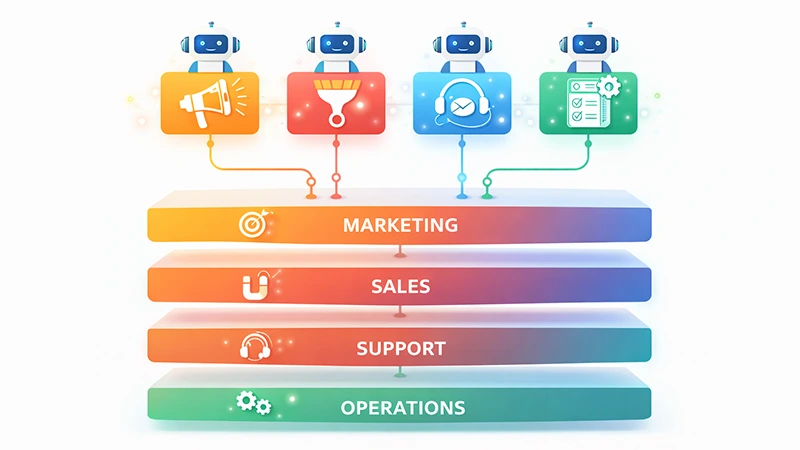
Goal: Build an AI stack that feels natural, not forced.
Once one tool is stable, add another only if it solves a different problem.
At this stage, many businesses expand into:
- Customer support automation
- AI-assisted marketing planning
- Lead scoring and follow-up systems
For example, when social engagement is connected to AI-driven sales workflows for small businesses, actions like comments, clicks, and reactions can automatically prompt timely follow-ups—without the need for manual tracking.
Important Rule
Never add more than one new AI tool at a time.
Momentum beats speed.
Step 6: Build an AI-Ready Business Culture (Ongoing)
Goal: Make AI adoption sustainable long-term.
AI works best when it’s seen as:
- A support system
- Not a replacement
- Not a threat
How to Reinforce This Culture
- Share small wins regularly
- Document workflows that include AI
- Encourage questions and experimentation
- Review AI usage quarterly
Over time, your business develops a natural habit:
“Is there an AI-assisted way to do this?”
That mindset—not tools—is the real competitive advantage.
Common AI Adoption Myths (And the Truth)
Myth 1: AI Is Only for Tech-Savvy Businesses
Reality: Most modern AI tools are designed for non-technical users.
Myth 2: AI Replaces Human Judgment
Reality: AI supports decisions; humans still decide.
Myth 3: You Need Big Data
Reality: Even small datasets deliver value when analyzed correctly.
How This Roadmap Fits the Bigger AI Picture
This roadmap focuses on adopting AI in a responsible, step-by-step way. However, adoption works best when you understand how AI supports the business as a whole—not just individual tools.
To see how AI brings marketing, sales, customer support, and operations together in a practical way, this article on how small businesses benefit from AI in real-world scenarios provides the broader context behind this roadmap.
Your 30-Minute Starting Point (Do This First)
You don’t need to finish this article to begin.
Do this today:
- Block 30 minutes on your calendar
- Write down 5 repetitive tasks
- Circle the most annoying one
That’s Step 1 complete.
Final Takeaway: AI Progress Beats AI Perfection
AI adoption isn’t about becoming “advanced.”
It’s about becoming less overwhelmed.
When done right, AI:
- Reduces mental load
- Creates consistency
- Frees time for strategic thinking
Follow this roadmap patiently. One task. One tool. One win at a time.
That’s how small businesses build lasting AI advantages—without burnout, wasted money, or confusion.
FAQ
A1: AI adoption for small businesses means using artificial intelligence tools to automate repetitive tasks, improve decision-making, and save time without needing technical expertise or large budgets.
A2: A small business should start by identifying one repetitive task, choosing one AI tool to solve it, and testing the tool in a low-risk pilot before expanding further.
A3: No. Many AI tools offer free or low-cost plans, and small businesses can adopt AI gradually without large upfront investments.
A4: Most modern AI tools are designed for non-technical users, with simple dashboards and guided workflows that require little to no technical knowledge.
A5: AI is most effective for content creation, customer support, sales follow-ups, scheduling, data analysis, and reporting—especially tasks done repeatedly.
A6: AI does not replace employees; it supports them by handling repetitive work so teams can focus on strategy, creativity, and customer relationships.