
You already know social media matters. However, knowing that and managing it well are two very different things.
At first, you open your phone with a clear goal—to post, engage, and grow your brand. Yet, an hour later, you realize you’ve only scrolled, drafted one caption, and scheduled nothing. As a result, consistency slips, momentum fades, and frustration builds.
This problem isn’t about effort. Instead, it’s about scale. Social platforms demand constant, high-quality output, while small business owners juggle sales, operations, and customer service. Consequently, social media often becomes reactive, inconsistent, or completely overwhelming.
That’s where AI changes the equation.
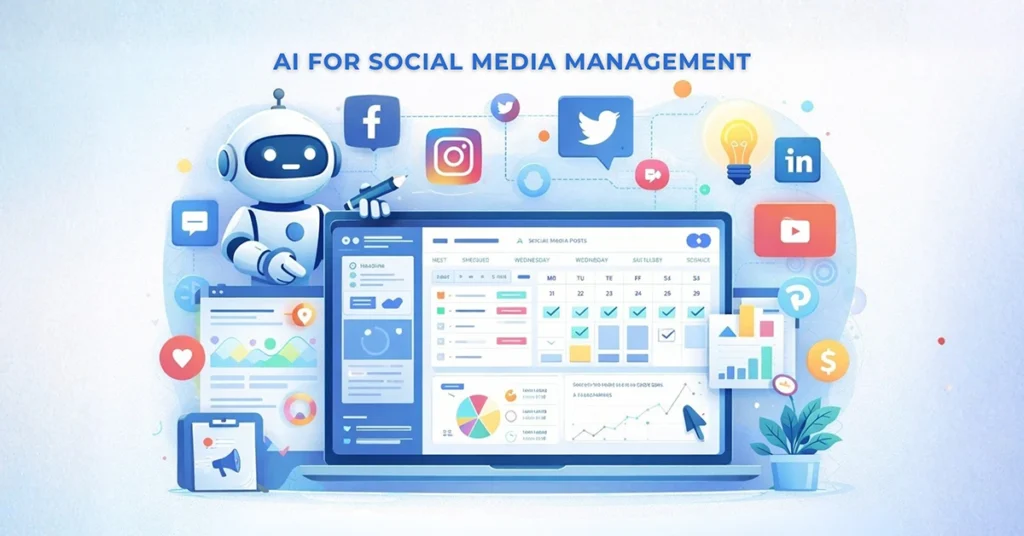
Rather than replacing creativity, AI now supports social media management by handling repetitive tasks. Therefore, you can focus on strategy, authenticity, and real engagement—without spending your entire day online.
The Problem: Social Media Drains Time Without Clear Returns
For most small businesses, social media breaks down into three exhausting challenges.
First, content creation consumes more time than expected. Coming up with ideas, writing captions, and finding visuals quickly becomes a daily struggle.
Second, scheduling adds another layer of complexity. Posting manually across platforms often leads to missed days and inconsistent timing.
Finally, engagement tracking feels endless. You respond when you can, analyze results occasionally, and still wonder what’s actually working.
As a result, social media turns from a growth channel into a constant distraction.
The Insight: AI Automates the Process—Not Your Personality
Fortunately, modern AI tools focus on execution, not identity.
In other words, AI doesn’t replace your voice. Instead, it supports it.
Specifically, AI acts as:
- A content assistant that helps generate ideas and drafts
- A scheduler that posts consistently at optimal times
- A data analyst that explains what’s performing well—and why
Because of this, AI removes friction from your workflow. Meanwhile, you stay in control of tone, message, and strategy.
The Solution: A Smarter AI-Powered Social Media Workflow

Below is how AI fits naturally into each stage of social media management.
1. AI for Content Ideation & Writing
The challenge: Staring at a blank screen week after week.
How AI helps: AI tools analyze your brand, past content, and audience preferences to suggest relevant ideas and captions.
Practical tools:
- ChatGPT or Claude for post ideas and first drafts
- Jasper or Copy.ai to maintain consistent brand voice
- Canva Magic Write for platform-specific captions
As a result, you can create weeks of content in one focused session.
2. AI for Visual Creation & Adaptation
The challenge: Creating professional visuals without design skills.
How AI helps: AI generates images, resizes designs, and adapts visuals for different platforms.
Practical tools:
- Canva AI Image Generator for unique graphics
- Adobe Express (Firefly) for smart image edits
- Pictory or InVideo AI for turning blogs into short videos
Therefore, one idea can easily become multiple visual assets.
3. AI for Scheduling & Optimization
The challenge: Posting consistently at the right time.
How AI helps: AI analyzes engagement patterns and schedules posts automatically.
Practical tools:
- Buffer or Hootsuite with AI assistants
- Later or Planable for audience-specific timing
Consequently, your content goes live when your audience is most active—without daily effort.
4. AI for Engagement & Performance Insights
The challenge: Understanding what actually drives results.
How AI helps: AI summarizes performance, highlights trends, and suggests next actions.
Practical tools:
- Sprout Social AI insights
- Repurpose.io or Missinglettr for content reuse
- ChatGPT for drafting thoughtful replies
Outcome:
As a result, you get clear insights instead of confusing dashboards.
At the same time, you gain more time for meaningful interactions.
How Social Media AI Connects to Sales Workflows

In practice, social media engagement often signals buying intent. However, that signal only becomes valuable when it leads to a clear next step.
For example, likes, comments, and saves usually indicate interest. At the same time, this data should not remain trapped inside social platforms where it fades quickly.
When paired with AI in small business sales workflows, engagement data can trigger timely follow-ups, surface warm leads, and guide prospects into the right stage of the funnel. As a result, interested users are far less likely to disappear after interacting with a post.
More broadly, understanding how AI is actually helping small businesses today explains why these connections matter. Instead of treating social media as a standalone channel, modern businesses increasingly integrate engagement data into their wider operations to drive measurable outcomes.
Additionally, this approach aligns closely with AI-driven sales automation for small teams, where social signals help prioritize outreach, personalize follow-ups, and reduce manual tracking across platforms.
Ultimately, this connection transforms social attention into real opportunities—without spreadsheets, guesswork, or missed follow-ups.
Your Starter Stack: Simple Tools That Work Together
| Main Challenge | Recommended Tools | Simple Workflow |
|---|---|---|
| Content ideas & captions | ChatGPT + Canva | Brainstorm → Design → Schedule |
| Consistent posting | Buffer or Hootsuite | Optimize timing → Auto-publish |
| Video creation | Pictory or InVideo AI | Blog → Video → Multi-platform |
The Bottom Line: Less Effort, Better Results
Ultimately, AI doesn’t make social media impersonal. Instead, it removes the friction that prevents consistency.
By automating repetitive work, you reclaim time for creativity, conversation, and strategy. As a result, social media becomes sustainable—not stressful.
Choose one task this week. Automate it. Then use the saved time to connect with your audience. That’s where real growth begins.
FAQ
A1: No. Instead, AI supports managers by handling repetitive tasks. As a result, humans focus more on strategy and creativity.
A2: Yes. However, it works best when trained on your past content. Therefore, always review and refine AI outputs.
A3: Generally, yes. Still, you should monitor automation closely to ensure accuracy and authenticity.
A4: Absolutely. When integrated with AI in small business sales workflows, social engagement can trigger follow-ups and lead prioritization.
A5: Not at first. Instead, start with one tool that solves your biggest problem and expand gradually.