Quantum computing is one of those ideas that sparks extreme reactions.
Some people talk about it as if it’s the next miracle technology that will instantly change everything. Others dismiss it as science fiction that will never escape research labs.
The reality sits firmly in the middle.
Quantum computing is real. It is advancing steadily. And while it won’t replace your laptop or phone, it will quietly reshape industries that deal with massive complexity — from medicine and energy to cybersecurity and artificial intelligence.
Before looking ahead, let’s slow down and get the basics right.
What Quantum Computing Actually Is (Without the Math Headache)
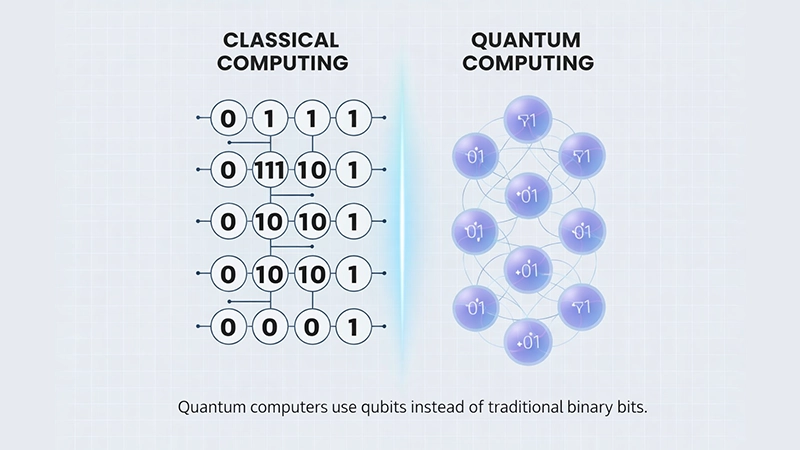
Traditional computers work with bits.
A bit can be either:
- 0
- or 1
Every app, website, game, and AI model you use today ultimately runs on long chains of these simple on-off switches.
Quantum computers work differently. Instead of bits, they use qubits.
A qubit can be:
- 0
- 1
- or both at the same time
This strange “both at once” state is called superposition.
Here’s an easy way to picture it:
- A classical bit is like a coin lying flat on a table — heads or tails.
- A quantum bit is like a coin spinning in the air — it represents both until it lands.
On top of that, quantum systems use two other key properties:
Entanglement
Entangled qubits become deeply linked. Change one, and the other changes instantly — even if they are far apart.
Interference
Quantum systems can amplify correct solutions and cancel out incorrect ones, helping guide calculations toward useful answers.
Together, these properties allow quantum computers to explore huge numbers of possibilities at the same time, rather than checking them one by one.
That’s the real breakthrough.
Quantum computers aren’t just “faster.”
They are built for problems classical computers struggle with.
The Problem: Why Classical Computers Are Hitting Limits
Classical computing has been incredibly successful. Faster CPUs, powerful GPUs, and specialized AI chips have carried us far.
However, some problems remain brutally difficult, even for the most advanced systems.
For example:
- Simulating complex molecules accurately
- Optimizing enormous systems with millions of variables
- Modeling atomic-level physics
- Solving certain cryptographic challenges
Even supercomputers must approximate these problems because calculating every possibility would take longer than the age of the universe.
As AI models grow larger and scientific questions grow more complex, those limitations become harder to ignore.
That’s where quantum computing enters the picture — not as a replacement, but as a new class of tool.
What Quantum Computers Are Actually Good At
Despite the hype, quantum computers are not designed for everyday tasks.
They are not good at:
- Gaming
- Browsing the web
- Running office software
- Streaming videos
- Powering chat apps
Instead, they excel at a narrow but powerful set of problems:
- Molecular simulation for chemistry and medicine
- Large-scale optimization problems
- Material design at the atomic level
- Certain cryptography challenges
- Scientific modeling that overwhelms classical systems
Think of quantum computers as computational microscopes.
They allow researchers to see and calculate things classical machines can’t, even if they aren’t useful for daily computing.
How Quantum Computing Will Change AI (In Realistic Ways)
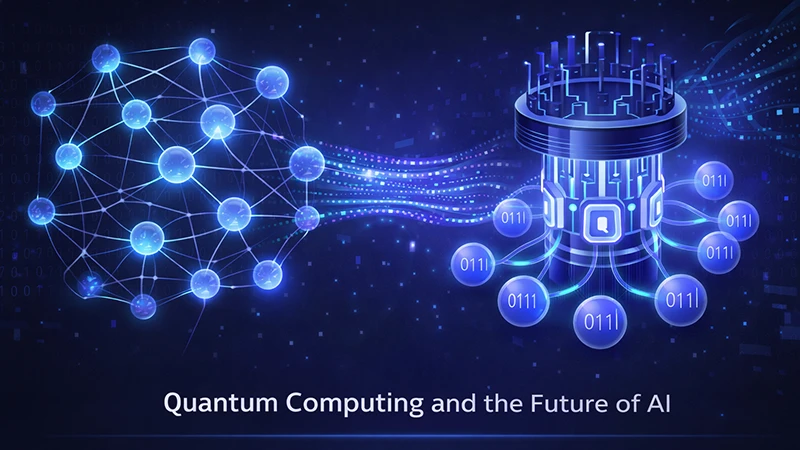
Quantum computing will not replace artificial intelligence.
Instead, it will enhance AI behind the scenes, especially in areas where math and optimization dominate.
1. Faster Training for Specific Models
Certain quantum algorithms may reduce the time needed to train extremely complex AI systems, particularly in research environments.
2. Better Optimization
AI relies heavily on optimization — adjusting millions or billions of parameters. Quantum systems are naturally suited to solving certain optimization problems more efficiently.
3. Breakthroughs in Chemistry and Drug Discovery
By combining AI pattern recognition with quantum simulation, researchers can design new molecules, materials, and medicines far faster than today.
4. New Algorithms Beyond Classical Limits
Quantum machine learning (QML) explores models that classical hardware simply cannot run efficiently.
In short, AI becomes more capable because the underlying math improves, not because quantum computers are “thinking.”
If you’re curious about how modern AI systems already process and optimize data today, our guide on how AI uses data and what users should know explains the foundations behind these advances.
What Quantum Computing Is Not Going to Do
Let’s clear up the biggest myths.
Quantum computers will not:
- Replace your laptop or phone
- Run your daily apps
- Power consumer AI assistants
- Become conscious machines
- Destroy classical computing
They are specialized systems, designed for specific workloads.
Just as GPUs didn’t replace CPUs — but transformed AI — quantum computing will sit alongside classical hardware, not above it.
Where Quantum Computing Will Matter Most (2025–2035)
Although consumers may never own a quantum computer, many industries will feel its impact.
Pharmaceuticals
Drug discovery and protein modeling will accelerate dramatically, reducing development time and cost.
Materials Science
New batteries, superconductors, and industrial materials will emerge faster through quantum simulation.
Finance
Portfolio optimization, fraud detection, and complex risk modeling benefit from quantum-enhanced optimization.
Energy
Quantum models help improve battery chemistry, solar materials, fusion research, and power grid efficiency.
Cybersecurity
Quantum computing will break older encryption methods, forcing a global shift to post-quantum cryptography.
Timeline: Realistic Quantum Progress (2025–2035)
2025 – More Stable Qubits
Research focuses on reducing noise and improving qubit reliability.
2026 – Early Quantum Advantage
Niche chemistry and optimization problems outperform classical systems.
2027 – Hybrid Quantum–Classical Systems
AI workflows begin combining GPUs with quantum accelerators.
2028 – Cloud Quantum Becomes Normal
Access through platforms like IBM, AWS, and Azure expands.
2029 – First Industrial Breakthroughs
Materials and pharmaceuticals show results impossible with classical computing.
2030 – Post-Quantum Security Rollout
Governments and enterprises migrate to quantum-safe encryption.
2031 – Mid-Scale Fault-Tolerant Systems
Quantum machines cross key reliability thresholds.
2032 – AI Research Gains Speedups
Hybrid quantum models become standard in top research labs.
2033 – Energy and Climate Advances
Quantum simulations accelerate clean energy innovation.
2034–2035 – Quantum as a Scientific Co-Pilot
Not in homes — but in labs, universities, and industry.
The Bottom Line
Quantum computing will not change how you check email or watch videos.
However, it will change the world behind the scenes:
- Faster drug discovery
- Cleaner energy
- Stronger cybersecurity
- More powerful AI research
- Accelerated scientific progress
Not magic.
Not science fiction.
Just the next major leap in how humanity computes — and understands — the universe.
FAQ
A1: Quantum computing uses quantum bits (qubits) that can process multiple possibilities at once, allowing it to solve certain complex problems much faster than traditional computers.
A2: No. Quantum computers are designed for specific scientific and optimization tasks, while classical computers will continue handling everyday computing.
A3: Quantum computing can improve AI training and optimization by solving complex mathematical problems more efficiently than classical systems.
A4: No. Current AI models run on classical hardware like GPUs. Quantum systems support research and optimization, not consumer AI apps.
A5: Quantum computing is expected to impact industries between 2026–2035, mainly in research, medicine, energy, and cybersecurity—not personal devices.
A6: Quantum computing may break older encryption methods, which is why governments and companies are developing post-quantum security standards.