There is a quiet rule that almost every video game follows — even when it pretends not to.
The world waits.
Traffic pauses when you stop.
NPCs forget what you did five minutes ago.
Chaos resets itself the moment you leave an area.
Over time, we’ve learned to accept this. Games are built around the player. The city exists for you.
However, Grand Theft Auto VI feels like it may be testing something far more unsettling:
What if the city doesn’t wait anymore?
When a Game World Stops Being a Stage
In previous GTA games, cities were massive theaters. Loud, busy, and convincing — yet ultimately obedient.
Every NPC had a role.
Every reaction had a limit.
Nothing truly escaped the script.
Artificial intelligence threatens that structure — not because it looks smarter, but because it changes how the world decides what to do.
Instead of reacting only to direct triggers, an AI-influenced city begins responding to patterns:
- Repeated violence in the same areas
- Persistent crime zones
- Player reputation built from behavior, not a visible stat
At that point, the city is no longer reacting to isolated events.
It’s reacting to you as a variable.
That’s when a game world quietly stops being a playground and starts behaving like a system.
Technology That Doesn’t Care About You
This is where the idea becomes uncomfortable.
Systems don’t hate you.
They don’t fear you.
They don’t admire you.
They optimize.
If crime creates instability, the system compensates.
If fear reduces unpredictability, fear spreads.
If pressure restores order, pressure increases.
No villain is required.
No dramatic cutscene is needed.
Just logic running without emotion.
In stories about intelligent cities and advanced systems, this is always the turning point — the moment technology stops serving individuals and starts managing behavior. Not maliciously, but efficiently.
If GTA VI leans into this idea, even subtly, the city stops being something you dominate and becomes an environment that pushes back.
NPCs With Memory Are Not NPCs Anymore
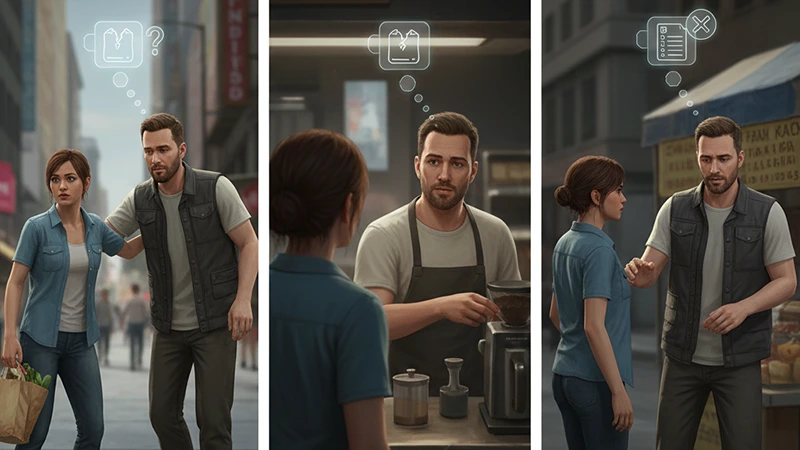
The most radical shift isn’t smarter enemies or prettier animations.
It’s memory.
Memory transforms disposable characters into consequences.
- A store clerk hesitates before serving you
- A street clears faster when your car appears
- Police responses escalate earlier than expected — not because of a mission, but because of accumulated tension
You don’t see the system working.
You feel it.
Suddenly, the player isn’t a hero moving between scripted scenes.
The player becomes a disturbance inside a living network.
The Illusion vs. the Reality of Intelligence
Here’s the truth most hype avoids:
True intelligence is unstable.
Emergent systems don’t respect pacing.
They don’t care about narrative beats.
They don’t conveniently turn off when a mission needs to work.
Rockstar knows this.
That’s why GTA VI is unlikely to feature full autonomy. Instead, the design will almost certainly rely on controlled intelligence.
A city that feels aware — but is quietly corrected.
A system that adapts — until it’s not allowed to.
That invisible tension between freedom and control is what defines the experience.
Too much intelligence, and the game breaks.
Too little, and the illusion collapses.
Hardware: The Invisible Limit of Intelligence
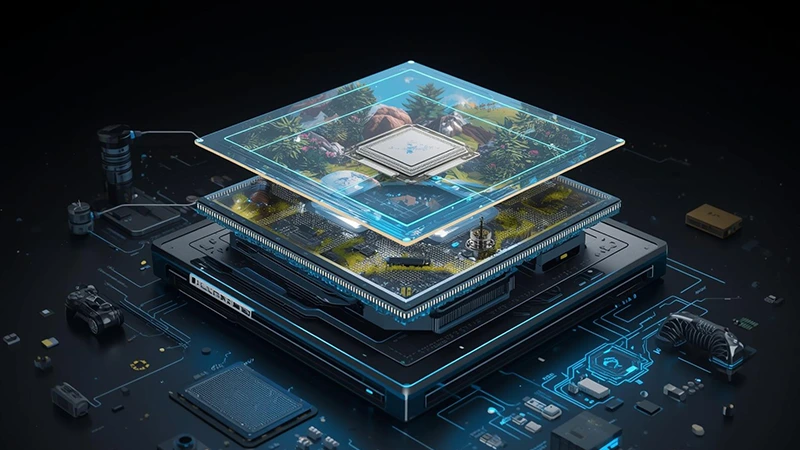
Every ambition eventually meets reality — and in this case, that reality is hardware.
AI doesn’t live on the GPU.
It lives in constant decision loops, memory checks, and probability evaluations.
That’s CPU territory.
On consoles, Rockstar can fine-tune every system.
On PC, reality fractures.
Different machines may not just render different graphics —
they may simulate different depths of behavior.
The same city.
Different intelligence.
It’s a quiet inequality no one will advertise — but players may feel.
The Risk Nobody Wants to Name: Almost Alive
The most dangerous outcome isn’t failure.
It’s almost success.
A city that feels smarter — but not enough.
NPCs that react — but forget too quickly.
Systems that hint at memory — but never fully commit.
Players fill the gaps with imagination.
And imagination always runs on maximum settings.
When reality loads at medium, disappointment hits harder than bugs.
Where Will Players Be Able to Play GTA VI?
At launch, Grand Theft Auto VI will be available on current-generation consoles, allowing Rockstar to tightly control performance and system behavior.
The confirmed launch platforms are:
- PlayStation 5
- Xbox Series X
- Xbox Series S
A PC version has not yet been dated, but based on Rockstar’s historical release patterns, it is widely expected to arrive later rather than alongside the initial console launch.
When the PC version does arrive, it will likely offer:
- Higher frame rates and resolution options
- Expanded performance and graphics settings
- Greater scalability depending on hardware capability
At this time, no cloud-based or streaming-only version has been announced.
How Will Players Get the Game?
GTA VI is expected to follow Rockstar’s traditional release model, offering both digital and physical options.
At launch, players will likely be able to purchase the game through:
- Digital storefronts such as the PlayStation Store and Xbox Store
- Physical disc editions for console players
Once the PC version is released, availability will likely expand to platforms such as:
- Rockstar Games Launcher
- Steam
- Epic Games Store
Rockstar has not officially confirmed pricing. However, industry expectations point toward a premium launch price, reflecting the scale and length of development — without any confirmed details at this time.
Why GTA VI Still Matters — No Matter What
Even if GTA VI only nudges the door open, the shift is permanent.
Once players sense a world that reacts — even imperfectly — scripted cities start feeling artificial. Static. Hollow.
After that, going back feels like downgrading reality.
That’s the real gamble Rockstar is taking.
Not whether AI works perfectly —
but whether players are ready for worlds that no longer revolve around them.
When Will GTA VI Launch?
After years of anticipation, Rockstar Games has officially confirmed the release date.
Grand Theft Auto VI will launch on Thursday, November 19, 2026.
Before this confirmation, Rockstar had previously targeted an earlier release window, which was later delayed as development continued. The studio has not framed the delay as a setback, but rather as part of its long-standing approach to shipping only when the experience meets its internal standards.
The game will debut first on current-generation consoles, allowing Rockstar to focus fully on performance, simulation depth, and long-term system behavior instead of balancing cross-generation limitations.
As with previous Rockstar releases, additional platforms are expected to follow later, once the initial launch window stabilizes.
The City as a System, Not a Promise
GTA VI doesn’t promise a living city.
It experiments with the idea of one.
A city that calculates instead of performs.
Remembers just enough to unsettle.
Responds not to actions — but to patterns.
Once a game world starts behaving like that, it stops being a fantasy of control.
It becomes something else entirely:
A system that runs —
with or without you.
FAQ
A1: Rockstar has not confirmed technical details, but GTA VI is expected to use advanced AI systems to improve NPC reactions, traffic behavior, and world realism.
A2: Yes. Rockstar has focused on deeper world simulation, making the city feel more reactive and less scripted than earlier GTA titles.
There is no official confirmation. However, the game may respond to repeated player behavior patterns rather than storing individual NPC memories.
A4: Grand Theft Auto VI will launch on Thursday, November 19, 2026.
A5: GTA VI will launch on PlayStation 5, Xbox Series X, and Xbox Series S. A PC release is expected later.
A6: AI allows the game world to react dynamically, making the city feel alive instead of scripted.