
Everyone knows the feeling.
You click a website.
Nothing happens.
You wait.
Your patience fades.
Then you leave.
Most people assume slow websites are caused by bad design, heavy images, or too many animations. Sometimes that’s true. However, in many real-world cases, the problem runs much deeper.
Very often, the real reason users experience slowness is something they never see and rarely think about: where and how the website is hosted.
Understanding this invisible layer explains why some websites feel instant while others feel frustrating — even when they look similar on the surface.
“Slow” Is About Feeling, Not Numbers
Website speed is not just a technical metric. More importantly, it’s a psychological experience.
A site doesn’t need to fully load to feel fast. Instead, it needs to react quickly.
When you click a link and something happens immediately, your brain relaxes.
When you click and nothing responds, your brain assumes the site is broken.
Even if the page finishes loading a few seconds later, trust is already lost.
That’s why two websites with similar loading times can feel completely different to users.
What Happens When You Open a Website (In Simple Terms)
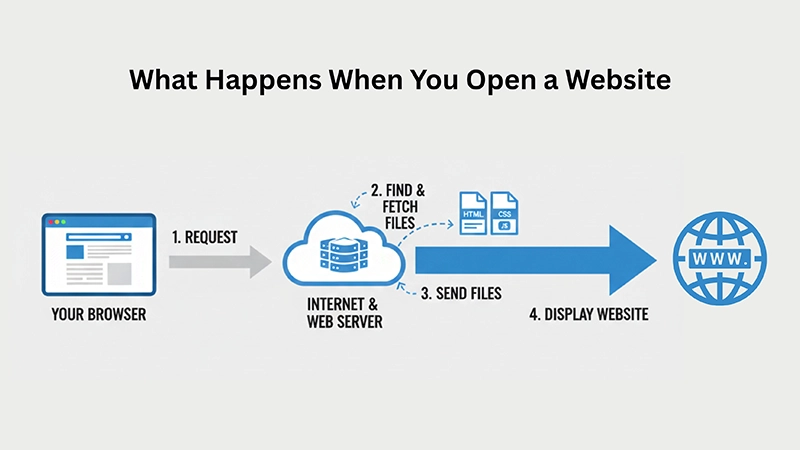
Behind every click, your browser performs a sequence of steps. Although this all happens in milliseconds, delays add up fast.
Here’s what actually happens:
- First, your browser asks the internet where the website is located
- Then it connects to the server where the site lives
- After that, the server prepares the page
- Finally, the content is sent back and displayed on your screen
If any one of these steps is slow, the entire experience feels sluggish.
As a result, website speed depends just as much on server response as it does on design or content.
Hosting Is More Than “Storage”
Many people think hosting is simply a place to store website files. In reality, hosting is much more than that.
Hosting is the engine of your website.
It controls:
- How quickly the site responds to clicks
- How many visitors it can handle at once
- How stable it feels during traffic spikes
- How consistent performance remains throughout the day
Even a beautifully designed site can feel slow if the engine behind it is weak.
Why Cheap Hosting Often Feels Slow
Cheap hosting plans usually mean one thing: resource sharing.
Your website doesn’t live alone. Instead, it shares a server with hundreds — sometimes thousands — of other websites. All of them compete for:
- Processing power
- Memory
- Disk access
- Network bandwidth
As a result, when one site suddenly gets busy, others slow down.
This explains a common mystery:
Why a website feels fast late at night but painfully slow during the day.
Opinion
Cheap hosting saves money upfront — but quietly costs users, trust, and conversions.
Distance Matters More Than People Think

Websites don’t live in the cloud. They live on physical machines in real locations.
If your website is hosted far away from your visitors, data must travel longer distances. That travel time creates delay, even if the server itself is powerful.
Think of it like ordering food:
- A nearby restaurant delivers quickly
- A restaurant across town takes longer, even if the food is great
That’s why many fast websites use Content Delivery Networks (CDNs). These systems store copies of your site closer to users, reducing travel time and improving responsiveness.
Why the First Response Is So Important
There’s a brief moment after a click where the website should “say hello.”
This first response tells your brain:
“Yes, I’m here. Everything is working.”
If that initial response is slow, everything afterward feels slow — even if the page loads quickly later.
Good hosting minimizes this delay by ensuring:
- Fast server response times
- Efficient request handling
- Stable performance under load
This single factor often determines whether users stay or leave.
A Simple Real-Life Example
Imagine two stores.
Store A opens the door instantly but takes time to prepare your order.
Store B keeps the door closed for a while, then suddenly hands you everything.
Most people prefer Store A.
Websites work the same way. Immediate feedback builds confidence, even if full content takes time.
Why Speed Affects Trust (Even If Users Don’t Realize It)
A slow website doesn’t just feel annoying. It feels:
- Unprofessional
- Unreliable
- Potentially unsafe
Users rarely think this consciously. Instead, they feel discomfort and move on.
Because of this, speed directly affects:
- How long visitors stay
- Whether they read content
- Whether they buy or sign up
- Whether they return
Search engines notice this behavior too. Poor engagement often leads to lower rankings over time.
What Actually Makes a Website Feel Fast
Contrary to popular belief, you don’t need complex tricks or extreme optimization.
What you really need are strong fundamentals:
- Hosting with enough dedicated resources
- Servers located near your audience
- Fast initial server response
- Clean, efficient site structure
- Basic optimization done correctly
Speed is built from the ground up. Without solid hosting, every other improvement struggles to compensate.
Choosing the Right Hosting Matters
If you’re building a website with WordPress or WooCommerce, hosting quality plays a major role in how fast your site feels to visitors.
Reliable hosting helps your site:
- Respond quickly to clicks
- Stay stable during traffic spikes
- Deliver a smoother user experience overall
Many site owners choose providers like Hostinger because they balance performance, reliability, and affordability — especially for growing websites that need consistency without complexity.
The key takeaway is simple: good hosting supports good experiences.
Why Speed Problems Are Often Misdiagnosed
When a site feels slow, people usually blame:
- Themes
- Plugins
- Images
- Code
While these can contribute, hosting is often the silent bottleneck.
In many cases, designers optimize everything they can — yet the site still feels heavy. That’s because no amount of front-end optimization can fully overcome slow server response.
How Hosting Impacts SEO Without You Noticing
Search engines don’t just measure load time. They measure user behavior.
If visitors leave quickly:
- Bounce rates increase
- Engagement drops
- Rankings slowly suffer
Fast hosting supports:
- Better crawl efficiency
- Faster indexing
- Improved user satisfaction
Over time, this creates a positive feedback loop that benefits visibility and trust.
The Real Cost of a Slow Website
A slow website is rarely broken.
More often, it’s underpowered.
Good hosting won’t make a bad site great.
However, bad hosting can make a good site feel frustrating.
And users won’t explain what went wrong.
They won’t complain.
They won’t give feedback.
They’ll just leave.
Final Thought
Website speed is not magic.
It’s not luck.
And it’s not just design.
It’s infrastructure.
When a site feels slow, the cause is often invisible — but the impact is very real. Choosing strong foundations early saves frustration later, both for site owners and for users.
FAQ
A1: Yes. Hosting directly impacts server response time, stability, and how quickly content is delivered to visitors. Even a well-designed site can feel slow on weak hosting.
A2: This usually happens on shared hosting. When other websites on the same server get busy, your site competes for resources and slows down.
A3: No. Speed affects user trust, engagement, conversions, and return visits. SEO benefits are a result of better user behavior.
A4: Only partially. Optimization helps, but it cannot fully overcome slow server response times or limited resources.
A5: Start with reliable hosting, servers close to your audience, and fast response times. Optimization works best when the foundation is strong.