Remember the last perfect photo you took. Not the one you painstakingly edited, but the one that just looked incredible straight out of the camera. The sky was vividly blue. Your friend’s face was perfectly lit. The blurry background made the subject pop.
Chances are, you thanked the hardware or the lighting. You almost certainly didn’t thank the artificial intelligence that orchestrated the moment.
We tend to notice AI when it’s in our faces: chatbots, voice assistants, or flashy photo filters we deliberately activate. But the most profound transformation is happening quietly — behind the scenes. Your smartphone is evolving from a reactive tool into a contextual, predictive, and deeply personalized companion. And it’s doing so so seamlessly that you don’t give it a second thought.
This is the silent revolution. You’re interacting with AI every time you pick up your phone — even if you call it “just good design.”
The Unseen Problem: Invisible Complexity, Unmet Expectations
We demand more from our phones than ever before:
- Studio-quality photos without learning photography
- All-day battery life while constantly using the device
- Flawless security without complex passwords
- Personalized experiences without feeling surveilled
This creates a paradox. To meet these sky-high expectations, the underlying technology must become enormously complex. And yet the user experience must become simpler, faster, and more intuitive.
The solution can’t be more buttons, menus, or settings. It has to be invisible intelligence — intelligence you never notice until it’s missing.
So when everything feels effortless, we don’t think “AI.” We think “Wow, this phone just gets me.”
The Core Insight: AI’s Greatest Strength Is Being Invisible
The most powerful AI isn’t the one that announces itself with a chatbot window or an AI assistant pop-up. It’s the one woven into the very fabric of your device’s operation — smart enough to anticipate, adapt, and automate without asking for attention.
This intelligence operates on one principle:
anticipate, adapt, automate.
It learns patterns, understands context, and executes micro-adjustments thousands of times a day to create a smoother, safer, and more efficient experience. The success of this system is measured by its invisibility.
Let’s pull back the curtain on the areas where AI is already in charge, working full-time without you noticing.
1. The Computational Photography Maestro

Your “point-and-shoot” moment is far from simple.
When you tap the shutter, AI is conducting a symphony:
- Scene & subject recognition
The camera identifies faces, pets, landscapes, or food and tailors processing profiles perfected on millions of examples. - Multi-frame fusion
The phone captures several shots at different exposures almost simultaneously. AI selects the best elements from each frame — bright areas from one, shadow detail from another — and combines them into one perfectly balanced photo. This is how modern night modes work. - Real-time enhancement
While you frame the shot, AI adjusts skin tones, sharpens key details, enhances skies, and reduces noise — all before you press the button.
You’re not just taking a photo — you’re directing an AI-powered imaging engine.
2. The Battery & Performance Guardian

Battery life and performance are no longer solely hardware problems. AI manages two precious resources with surprising efficiency:
- Usage learning
Your phone learns your daily routines — the apps you open at 8 AM, the ones you use at lunch, and the ones you check before bed. - Predictive allocation
Based on patterns, it pre-loads apps you commonly use at certain times and restricts background activity for others. It even learns your charging schedule, delaying a full 100% charge until just before your usual wake-up time to preserve battery health. - Thermal management
During demanding tasks, AI shifts workloads between CPUs and GPUs to deliver speed without overheating — keeping performance smooth without turning your phone into a hand-warmer.
This isn’t random optimization — it’s tailored intelligence trained on your behavior.
3. The Security Sentinel

Security has shifted from static passwords to dynamic, context-aware protection systems:
- Behavioral biometrics
Beyond fingerprints and face unlock, AI learns patterns like how you type, swipe, and hold your device. When behavior diverges significantly from your learned profile, the phone can trigger additional authentication before granting access. - On-device threat analysis
Instead of sending every file or app to the cloud for scanning, today’s AI can analyze suspicious activity locally. This protects your privacy while responding faster to threats. - Real-time fraud detection
AI watches for patterns in communications and financial apps that match known scam or phishing signatures — alerting you before you even interact.
Security is no longer passive. It’s proactive and constantly learning.
4. The Anticipatory Assistant
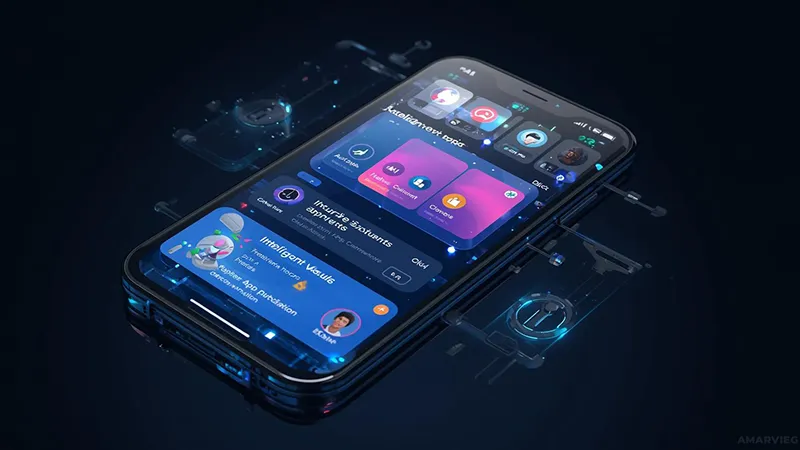
Your phone isn’t waiting for you to tell it what to do — it’s predicting what you might need next:
- Proactive suggestions
Put in headphones at 8 AM? Your favorite podcast and commute playlist appear automatically. Arrive at the gym? Your workout playlist is ready. This isn’t simple location tracking; it’s deep contextual intelligence. - Smart text & writing aid
Autocorrect has evolved into predictive text that understands your style — formal for email, casual for messaging. It avoids embarrassing mistakes and even predicts complete phrases. - Audio intelligence
Background noise suppression during calls, separation of voices, and real-time live captions for media aren’t add-ons. They’re built-in AI features designed to make communication clearer without extra effort.
The line between proactive assistance and automation is blurring — and that’s a big shift.
5. The Personalization Engine
The user interface today is rarely static. Your phone changes with you:
- Adaptive UI & widgets
Your home screen might prioritize different apps or widgets based on the time of day and your habits — something you never configured manually. - Smarter search & app discovery
When you swipe down to search, the results you see are ranked not just by name, but by likelihood you’ll need them right then. - Network optimization
AI manages transitions between Wi-Fi and cellular based on signal quality, not just availability. It predicts weak connections and switches ahead of time so calls and video streams stay smooth.
These are small shifts, but they add up to an experience that feels inherently personalized without effort.
The Quiet Trade-Off: Convenience vs. Consciousness
This seamless integration comes with a subtle, important trade-off.
As our devices get better at predicting what we need, we become less consciously aware of how they operate. The processes that once required active decisions become automatic, almost magical.
The risk isn’t that AI will take control.
The risk is that you stop paying attention to how technology shapes your decisions and behaviors.
But abandoning AI is not the answer — the benefits are too great.
The answer is informed awareness.
Your Role in the AI Partnership
You aren’t a passive user. You are a participant in training your device — consciously or not.
Here are ways to stay engaged:
- Respond to feedback prompts
If your phone suggests edits or improvements, accept or reject them consciously — this trains your device. - Review privacy & personalization settings
Visit your privacy dashboard and understand what data is used for predictions. Adjust permissions to maintain control. - Recognize the work happening in the background
When your phone delivers a perfect photo, long battery life, or a smart suggestion, acknowledge the technology at work — not as magic, but as evolving computation.
This mindset changes your relationship with your device from consumer to collaborator.
Why This Matters More Than You Think
This silent transformation is reshaping the smartphone experience in ways most people never talk about.
It’s tied to broader shifts in how software behaves. If you haven’t yet read our post on How AI Is Used in Everyday Apps (Real Examples Explained), that article explores how AI quietly improves software workflows across platforms.
To understand where this is going at a system-wide level, you might also enjoy Is AI Replacing Our Daily Apps? The Truth You Need to Know — which explains how AI reshapes experience without erasing the tools we rely on.
Together, these perspectives show a consistent story:
AI is not eliminating functionality — it’s abstracting effort.
Final Thoughts
The transformation happening in your pocket is not dramatic in appearance, but profound in impact.
Your smartphone isn’t just getting smarter — it’s becoming more anticipatory, more adaptive, and more aligned with your life patterns. The AI inside your device will continue to evolve and become more central to everyday interactions.
The goal is not to replace human intuition — it’s to augment it, handling the mundane so you can focus on the meaningful.
FAQ
A1: Yes. Most AI functions — like personalization, power management, and context-aware suggestions — run quietly in the background to improve your experience without a visible interface.
A2: Many of these AI features operate on-device without internet access, which improves speed and protects privacy. However, some cloud-assisted features may still require connectivity.
A3: AI uses data to personalize experiences, but modern smartphones allow you to control what data is shared. Reviewing privacy settings ensures transparency and control.
A4: Not necessarily. Smartphones and computers will continue to coexist, each optimized for different use cases. AI will enhance both, but not fully replace either.
A5: Awareness is key. Understand which features use your data and how. Responsible use and privacy settings help you benefit while staying in control.
The quiet revolution is happening right in your pocket.
AI isn’t flashy. It’s functional — and it’s already transforming the way you interact with your world.
If you want deeper insights on how technology quietly shapes everyday tools, stay with Techo Hype — where we explain tech clearly, without hype.
👇 Explore more tech insights and guides in our blog.