As 2025 comes to a close, the DRAM market remains in one of its tightest cycles in over a decade. For anyone planning a PC upgrade, the outlook heading into 2026 is still expensive.
The combination of AI-driven demand, strict supply discipline, and next-generation memory transitions continues to push RAM prices higher worldwide.
Here’s the clean, technical breakdown — updated for late 2025 and looking ahead to 2026, including where DDR6 really stands.
2025–2026 Market Reality: RAM Prices Are Still Rising
As of late 2025, the trend is clear: DRAM prices remain elevated, with no meaningful pullback visible going into early 2026. The reasons are structural, not temporary.
Key factors keeping prices high include:
- Manufacturers are still not returning to full production capacity
- AI data centers are consuming unprecedented amounts of DRAM and HBM
- DDR4 supply continues to shrink
- DDR5 demand is rising faster than expected
Even as 2026 approaches, memory pricing pressure remains firmly in place.
AI Is Crushing the DRAM Supply Chain
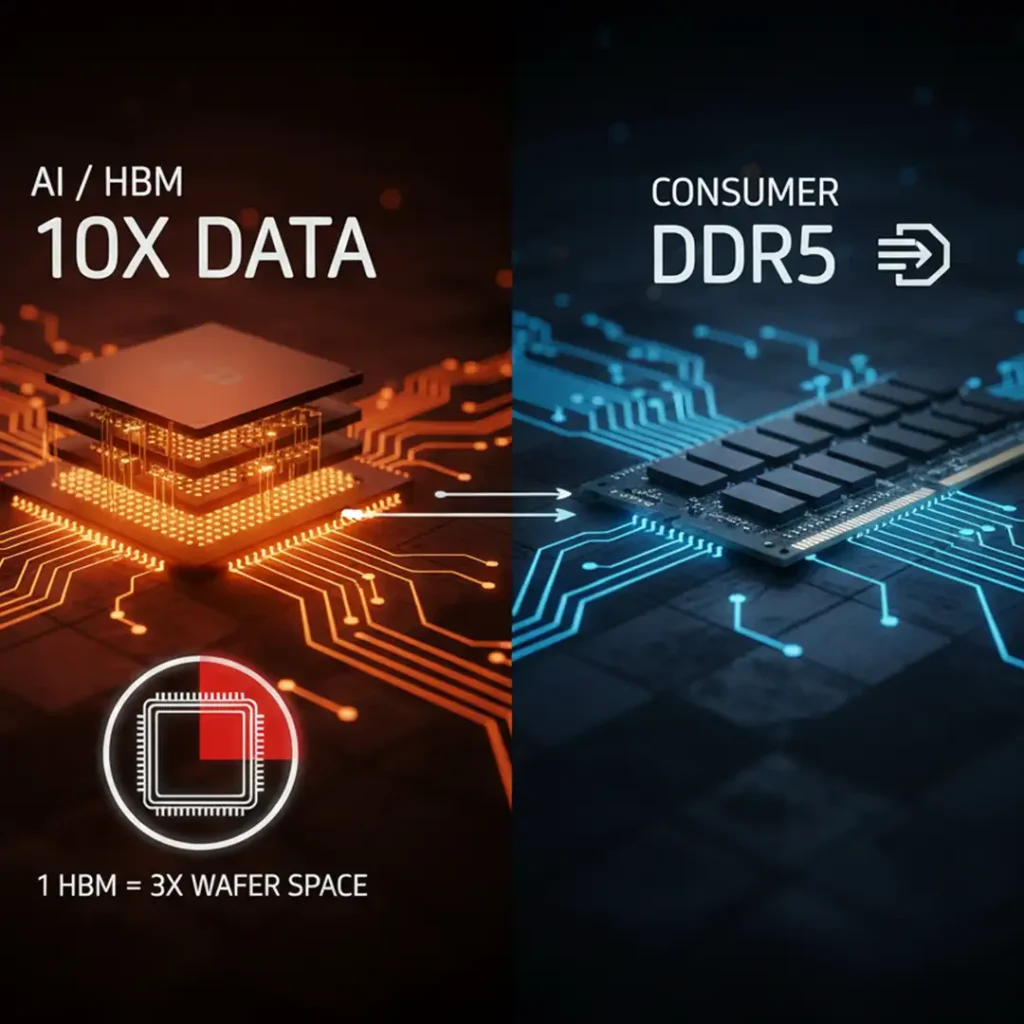
taking priority over consumer RAM, contributing to price hikes.
This is the single biggest factor affecting RAM prices today.
AI servers now consume up to 10× more DRAM than traditional cloud servers from earlier years. Hyperscalers such as Nvidia, Amazon, Google, Meta, and OpenAI continue to buy massive volumes of memory for AI training and inference.
Every wafer used to produce HBM (High Bandwidth Memory) is a wafer not producing DDR4 or DDR5 for consumer systems.
The result is simple:
Even if consumer PC demand stays flat, RAM prices rise because supply is being redirected toward AI workloads.
DDR4: Becoming “Legacy Hardware” Heading Into 2026
DDR4 is rapidly moving into legacy territory.
Manufacturers are actively phasing it out, which leads to:
- Lower overall production
- Higher cost per unit
- Rising retail prices
This is the same path DDR3 followed in previous years:
rare → overpriced → frustrating to buy.
If you’re planning a DDR4 upgrade as 2025 ends or in early 2026, expect prices to remain higher than expected.
DDR5: The New Standard — But Still Not Cheap
DDR5 has clearly become the default platform for new systems, but that does not mean it’s affordable yet.
Several factors are keeping DDR5 prices elevated:
- Strong adoption across Intel and AMD platforms
- AI PCs pushing 32 GB as the new normal
- Manufacturers splitting production capacity between DDR5 and HBM
DDR5 is now the standard going into 2026 — but it has not reached true “budget” pricing.
DDR6: Yes, It Exists. No, You Can’t Buy It Yet.
There’s a lot of confusion around DDR6, so here’s the reality without hype.
of DDR5 for AI and gaming.
DDR6 is already standardized
JEDEC has finalized the DDR6 specification. It is real and officially defined.
DDR6 is not available to consumers
There are currently:
- No consumer CPUs
- No motherboards
- No DDR6 DIMMs available for sale
Real-world availability is still years away
Initial DDR6 deployments are expected around 2026–2027, and even then, they will likely appear first in enterprise or specialized hardware.
Manufacturers still need time to develop:
- New memory dies
- New controllers
- New production lines
- Extensive validation and testing
DDR6 is not affecting current RAM prices
The high RAM prices seen in late 2025 are driven by AI demand and limited supply — not by DDR6.
What this means for consumers
- DDR5 is the only realistic forward-looking option
- DDR6 hardware does not exist for consumers yet
- Waiting for DDR6 means delaying upgrades for roughly two years
If you need memory now, waiting for DDR6 is not practical.
AI PCs Are Raising the Minimum RAM Requirement
The rise of AI PCs with on-device NPUs (Neural Processing Units) is changing baseline expectations.
As we head into 2026:
- 16 GB is the minimum acceptable configuration
- 32 GB is becoming the recommended standard
- 64 GB is increasingly viewed as the new “pro” baseline
This shift alone continues to push demand upward and keeps prices elevated.
Spot Market Volatility Continues Into 2026
RAM pricing remains volatile, even late in the year.
Prices can fluctuate week to week because:
- Distributors expect ongoing shortages
- Inventory is held longer to maximize margins
- HBM demand creates ripple effects across all DRAM products
Any short-term price dip is likely temporary and may only last a few days.
The Bottom Line Going Into 2026
Here’s the blunt summary as 2025 ends:
- DDR4 → Phasing out, prices rising
- DDR5 → Strong demand, still expensive
- HBM → Consuming wafer capacity
- AI → Massive pressure on global DRAM supply
- DDR6 → Real, but not consumer-ready before 2026–2027
For consumers:
If you need RAM heading into 2026, waiting is unlikely to save money. Prices remain high, and supply pressures are still very real.
FAQ
A1: RAM prices remain high mainly because AI data centers are consuming massive amounts of memory, especially HBM. At the same time, manufacturers are keeping production tight, and older memory like DDR4 is being phased out. Together, these factors keep supply limited and prices elevated.
A2: There’s no strong sign of a major price drop in early 2026. While short-term fluctuations may happen, ongoing AI demand and controlled production mean prices are likely to stay high rather than fall significantly.
A3: If you need the upgrade, waiting usually won’t help. In many cases, delaying can actually cost more later. For most users, upgrading to DDR5 now is the most practical option despite higher prices.
A4: For most consumers, waiting for DDR6 doesn’t make sense. DDR6 hardware won’t realistically reach consumers until 2026–2027, and even then it will be expensive at launch. DDR5 remains the best forward-looking choice right now.
A5: As AI features become more common, 16 GB is now the minimum, 32 GB is the recommended standard, and 64 GB is increasingly common for professional or heavy workloads.