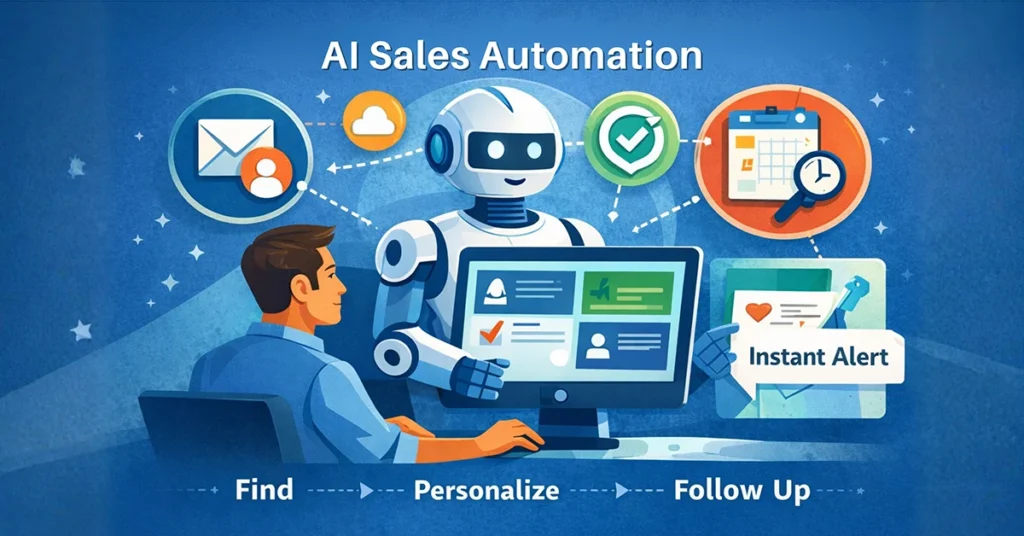
Imagine this: A qualified lead visits your website, downloads your pricing guide, and looks at your case studies. In 2024, you might find out days later—if you’re lucky. In 2026, before they’ve even closed the tab, your AI sales assistant has already scored their interest, found their professional email on file, and sent them a personalized follow-up. A meeting is on your calendar by lunch.
This isn’t a fantasy reserved for corporations with huge CRMs. For the small business owner, AI sales automation has become the great equalizer. It’s the system that ensures no lead falls through the cracks, no follow-up is forgotten, and your limited sales time is spent only on the prospects who are ready to buy.
If you’re still managing sales with spreadsheets, sticky notes, and a hopeful memory, you’re not just working hard—you’re working against a new standard of efficiency. Let’s talk about the tools that are putting modern sales pipelines on autopilot.
The Problem: Your Greatest Sales Asset Is Wasted on Admin
For a small business owner or a solo salesperson, the sales process is a leaky bucket. Brilliant at the conversation? Absolutely. But the process around it is where deals die:
- The Manual Hunt: Spending hours scouring LinkedIn and company websites to find the right contact for a prospect
- The Follow-Up Black Hole: Forgetting to circle back with a warm lead because you got busy with delivery
- The Generic Pitch: Sending the same templated email to everyone because personalizing each one is impossibly time-consuming
- The Data Disconnect: A great conversation happens, but the notes get lost, and the next touchpoint feels clumsy and out of context
You entered business to solve problems and serve clients, not to be a data-entry clerk and a calendar nag. This manual grind caps your growth and burns you out.
The Insight: AI Is Your Persistent, Omniscient Sales Coordinator
Think of AI sales automation not as a robot taking your job, but as the ultimate sales development representative (SDR) and project manager you could never afford to hire.
This assistant works 24/7 and excels at the three things that drain human salespeople:
- Finding & researching who to talk to
- Personalizing at scale based on real intent signals
- Remembering & orchestrating follow-ups without dropping the ball
Its core function is to fill your calendar with warmer leads and arm you with better information, so every sales conversation you have is more likely to succeed.
Sales automation is just one part of how AI is reshaping modern small businesses. From customer support to marketing insights and daily operations, the same principles apply—saving time, improving decisions, and reducing manual work. If you want a broader understanding of how small businesses are using AI across everyday workflows, our complete guide breaks down these applications in a practical, non-technical way.
The Solution: The 2026 AI Sales Automation Stack
Here’s how AI integrates into each stage of a modern small business sales funnel.
1. AI for Prospecting & Lead Enrichment
The task: Finding the right people and understanding their business before you reach out.
How AI helps: Tools scan publicly available data—company websites, LinkedIn profiles, news mentions—to build detailed lead profiles automatically.
Practical example:
A boutique cybersecurity firm uses Clay.com or Apollo.io. When a lead from a mid-size retail company downloads a whitepaper, the AI enriches the profile instantly:
“This company uses a competing security platform, recently hired an IT Security Manager, and is expanding into Europe.”
Your outreach email now references their specific situation—not a generic pitch.
The outcome: You start conversations with insight instead of guesswork. Relevance becomes your advantage.
2. AI for Personalized Outreach & Follow-Ups
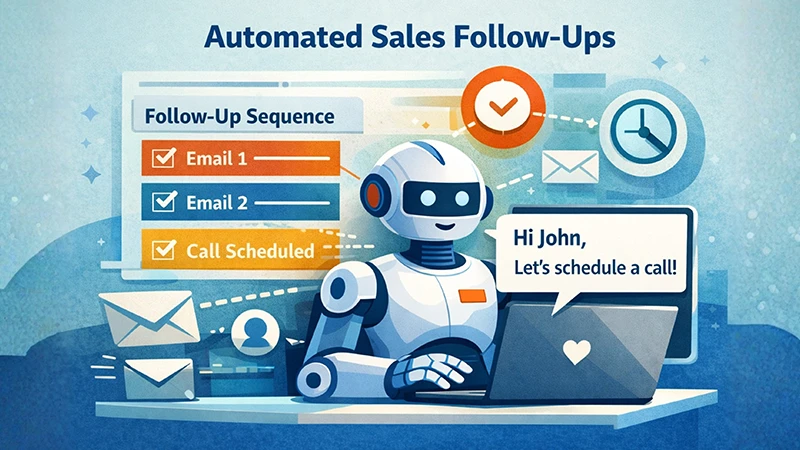
The task: Sending timely, relevant messages that don’t feel automated.
How AI helps: AI-powered email sequencing adapts based on how leads behave—not just on timers.
Practical example:
Using HubSpot Sales Hub or Smartlead, you set a sequence:
- If a lead opens your email multiple times but doesn’t click, the AI sends a softer follow-up
- If they visit your pricing page, the AI switches to a more direct sales message
The outcome: Each prospect experiences a personalized journey, leading to higher reply and conversion rates.
3. AI for Proposal & Quote Generation
The task: Turning interest into a professional proposal—fast.
How AI helps: Proposal tools auto-fill documents using CRM data and call notes.
Practical example:
After a discovery call, you generate a proposal in PandaDoc or Qwilr. The AI pulls in:
- Client name and company
- Discussed services
- Relevant case studies
You review, tweak, and send—all within minutes.
The outcome: Faster turnaround keeps momentum high and improves close rates.
4. AI for Call Preparation & Sales Insights
The task: Showing up to calls fully prepared.
How AI helps: AI analyzes call recordings and notes (with consent) to surface insights and objections.
Practical example:
Using tools like Gong, Chorus.ai, or Fireflies.ai, you receive summaries such as:
- Key concerns raised
- Decision-makers involved
- Suggested talking points for the next call
The outcome: Better conversations, stronger rapport, and fewer missed opportunities.
Your 2026 Starter Stack: Tools That Work Together
| Sales Bottleneck | Starter Tool | First Step |
|---|---|---|
| Leads going cold | HubSpot CRM (Free) or Smartlead | Create a simple 3-email follow-up sequence |
| Too much manual research | Clay.com or LinkedIn Sales Navigator | Enrich lead profiles automatically |
| Slow proposals | PandaDoc or Qwilr | Build one reusable proposal template |
| Missed call insights | Fireflies.ai or Gong | Record and review call summaries |
How to Start Without Overwhelming Your Process
- Document one sales process that already works
- Automate the most repetitive step first
- Feed AI your best-performing emails and proposals
- Review weekly—don’t fully hand over control
The Bottom Line: Automate the Process, Not the Relationship
AI sales automation in 2026 isn’t about replacing human connection. It’s about making sure the right conversations happen at the right time.
By automating the busywork—research, follow-ups, reminders—you free yourself to do what only humans can do: build trust, handle objections, and close deals.
Stop being the entire sales department.
Start being the closer.
Let AI manage the pipeline—so you can focus on the handshake.
FAQ
A1: In 2026, customer expectations have shifted toward faster responses and personalized communication. AI helps small businesses meet these expectations without hiring a full sales team, making it a competitive necessity rather than a luxury.
A2: Not necessarily. Many AI sales tools offer free plans or affordable starter tiers designed specifically for small businesses. Tools like HubSpot CRM, Smartlead, and Fireflies.ai allow businesses to start automating sales workflows with little to no upfront cost.
A3: No. AI handles admin-heavy tasks such as data entry, scheduling, and follow-ups. Human salespeople remain essential for relationship-building, negotiation, and closing deals. AI supports sales teams—it doesn’t replace them.
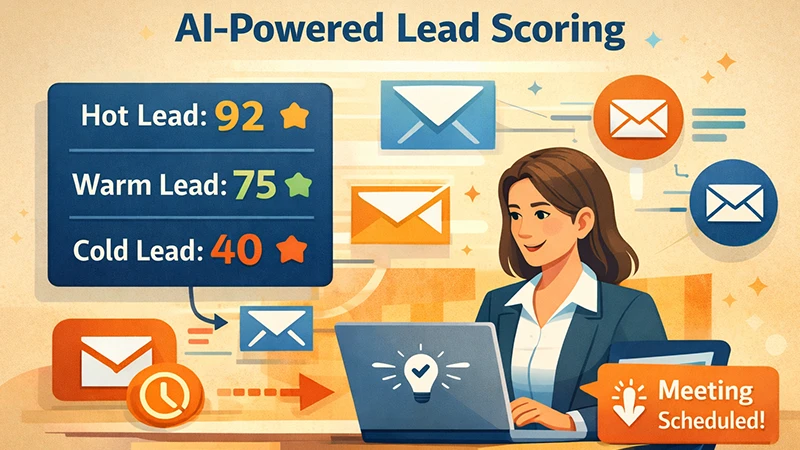
A4: AI lead scoring is typically more accurate than manual methods because it analyzes multiple data points such as website behavior, email engagement, and past conversions. While not perfect, it significantly improves prioritization and reduces guesswork.
A5: Yes. Modern AI tools generate emails based on real user behavior and context, making messages feel natural and relevant. When trained on your best-performing emails, AI can closely match your brand voice.
A6: Most modern tools are designed for non-technical users. Setup usually involves connecting your CRM, choosing a template, and defining simple rules. Many businesses can get started in under an hour.
A7: The best place to start is follow-ups. Automated follow-up sequences ensure no lead is forgotten and often deliver the fastest improvement in response and conversion rates.